
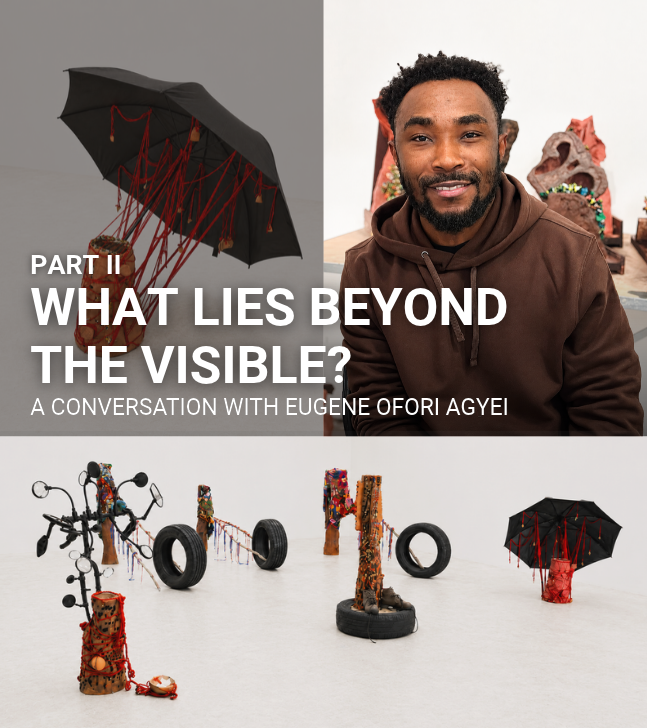
What Lies Beyond the Visible
A Conversation with Eugene Agyei, Part II
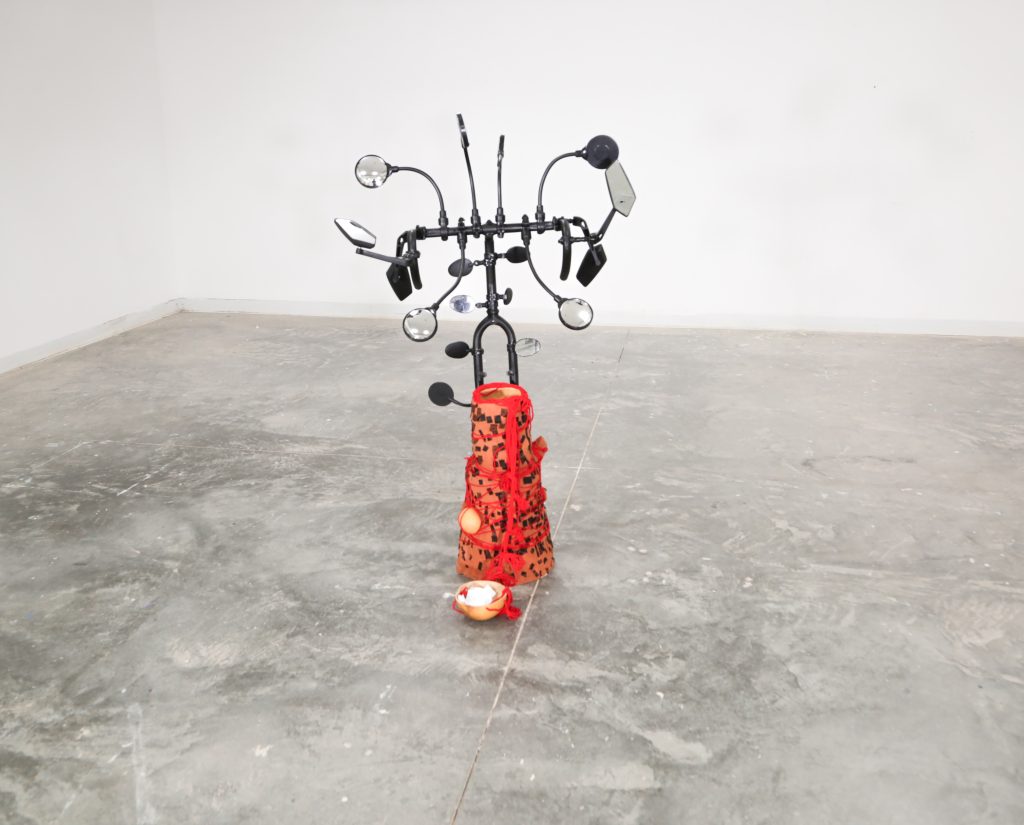
In the piece What’s behind?, at the moment of collecting and implanting the mirrors, what was your true intention? Are they intended to look toward the past (behind) or to force viewers to see themselves reflected in the work?
In What’s Behind?, the mirrors look in two directions. They invite us to reflect on memory, history, and the experiences that shape who we are, while also bringing viewers into the work by reflecting their sense of self or image. I used the mirrors not simply as reflective surfaces, but as materials that question identity, visibility, and perception. They encourage viewers to see themselves within the narrative, suggesting that identity is shaped by both what we inherit and what we continue to reconstruct. The work becomes a meeting point between personal memory, collective history, and the present moment.
Eugene Ofori Agyei
What’s behind?
2024
Earthenware clay, batik fabric, calabash, mirror, found object
53” x 30” x 11”
In the series Return(ning), you use fabrics from the Akan tradition that dialogue with batik. Since batik is a technique that has traveled the world for thousands of years, how do you navigate using a material that is outside your direct cultural heritage? Do you see it as an appropriation or as a reflection of your own global mobility?
In the Return(ning) series, my use of batik comes from an understanding of culture as something that is constantly moving, adapting, and being transformed through human connection. I am aware that batik has a complex history and that its origins are connected to communities beyond Ghana, particularly in Indonesia and other parts of the world. I do not approach the material as something I own or as a symbol that belongs exclusively to me. Instead, I engage with it through the histories, journeys, and exchanges that have allowed the material to arrive in Ghana and become part of my own visual and cultural environment.
Growing up in Ghana, batik was not foreign to me. It was part of the everyday landscape—present in clothing, markets, ceremonies, and social expressions. The fabrics I use often carry multiple histories: they may have originated from Indonesia, been produced or printed through global networks, and then become embedded within Ghanaian cultural life. This layered movement reflects my own experience as someone whose identity has been shaped by migration and encounters across different places.
For me, working with batik is less about appropriation and more about acknowledging relationships. I am interested in how materials travel, how they acquire new meanings, and how people create connections with objects that move across borders. My use of batik is not an attempt to claim another culture’s tradition, but rather to explore the shared histories and exchanges that shape contemporary identities.
In Return(ning), the dialogue between Akan textiles and batik reflects my own position between places. The materials speak to return, but not as a simple journey back to an unchanged origin. Instead, they represent a return that is transformed by movement—a return carrying memories, influences, and experiences gathered along the way.
Eugene Ofori Agyei
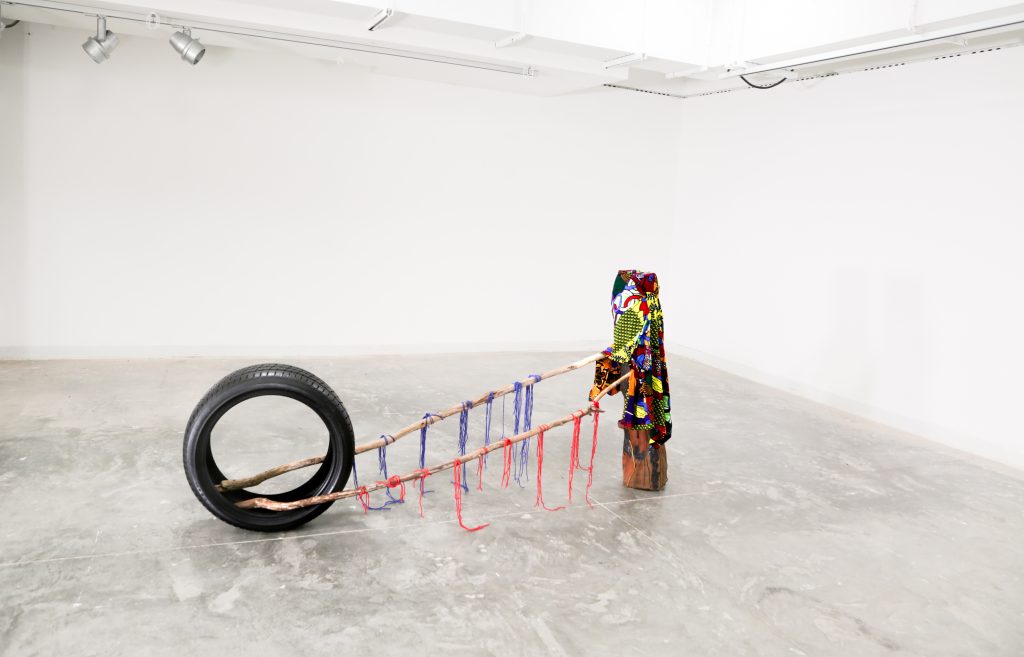
Return(ing)
2024
Earthenware clay, batik fabric, tree branch, shoelace, found object
41” x 8” x 72”
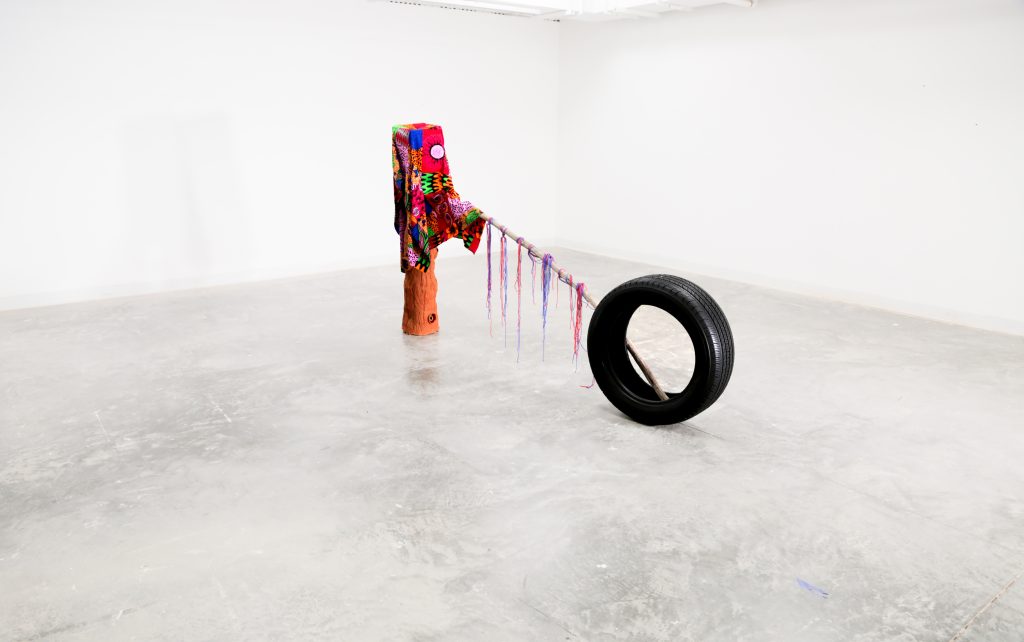
The series Return(ning) uses a title in the gerund, which implies an action that does not end. Where is one attempting to return to? Is the return a real goal or a permanent state of mind for the migrant?
The title Return(ning) intentionally uses the gerund form to suggest that return is not a fixed destination or a completed action. For me, returning is not simply about going back to a physical place; it is an ongoing process of reconnecting, remembering, questioning, and redefining what home means.
The place one attempts to return to is not always the place that was left behind. Migration changes both the person who leaves and the place they return to. The Ghana I remember continues to exist within me, but it is also transformed by time, distance, and experience. In that sense, return becomes less about recovering a past that no longer exists and more about engaging with the memories, traditions, and relationships that continue to shape my identity.
For many migrants, return can become a permanent state of consciousness, a feeling of being connected to multiple places while never fully belonging to only one. There is a constant movement between memory and the present, between where we come from and where we are becoming. The act of returning happens internally as much as physically.
Through Return(ning), I explore this tension between departure and belonging. The work considers return as a continuous negotiation rather than a final arrival. It is about carrying fragments of home with us, transforming them through new experiences, and understanding that identity is always in motion.
Eugene Ofori Agyei
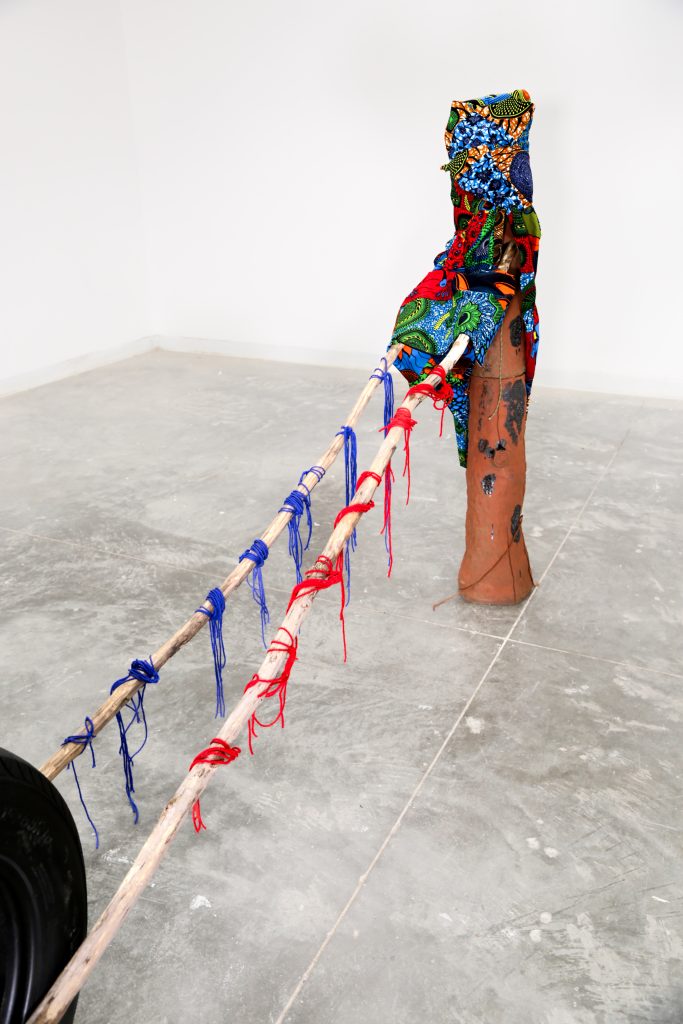
Return(ing) II
2024
Earthenware clay, batik fabric, tree branch, shoelace, found object
53” x 7.5” x 73”
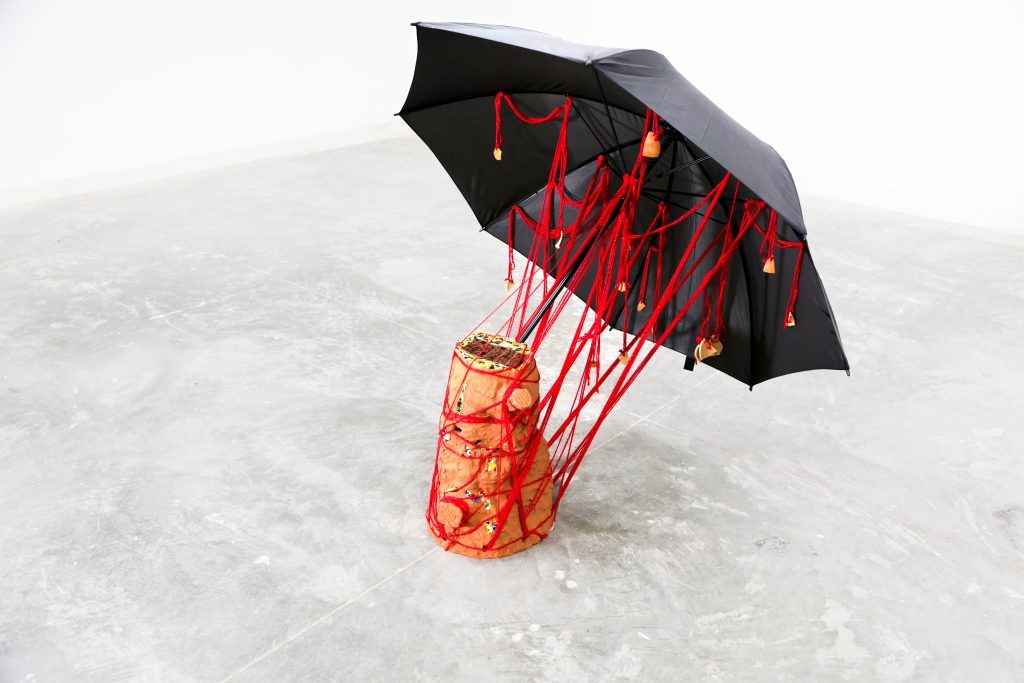
In Fruitful Umbrella, you contrast a black umbrella with a terracotta ceramic piece and hanging calabash elements. What does the umbrella mean to you? Is it a symbol of refuge or an irony about the vulnerability that a body in transit can feel?
In Fruitful Umbrella, the umbrella symbolizes both protection and vulnerability. Growing up in Ghana, it was an everyday object that offered shelter from the rain and sun, and in this work it becomes a metaphor for the refuge we seek while navigating unfamiliar places. At the same time, an umbrella can only provide limited protection, reminding us of the uncertainty that comes with migration. Paired with terracotta and calabash elements, it speaks to ancestry, nourishment, resilience, and growth. The work connotes that even through displacement and uncertainty, there is the possibility of finding new forms of belonging.
Eugene Ofori Agyei
Fruitful Umbrella
2024
Earthenware clay, batik fabric, calabash, found object
40” x 28” x 30”
As a sculptor who works with clay—a material that is baked, hardens, and freezes in time—how do you manage to convey the sensation of perpetual movement and fluidity in an object that is physically static?
Although fired clay becomes permanent, I don’t see it as a material of stillness. It holds the memory of movement—the gestures, rhythms, and decisions made through the process of making. I use form, installation, and materials like fabric, yarn, wood, and found objects to create a sense of transition between movement and stillness. Clay itself transforms through earth, water, touch, and fire, mirroring experiences of migration and identity. Rather than depicting physical movement, my sculptures capture the emotional and psychological experience of being in between—between departure and arrival, memory and presence, and belonging and displacement.
Eugene Ofori Agyei
Return(ing) III
2024
Earthenware clay, batik fabric, tree branch, shoelace, found object
52” x 8” x 72”
Outside of academia, how do you experience that duality between your day-to-day as a professor and artist in the United States? Do you feel that your work is a bridge for others to understand the “other”?
Outside of academia, I see my life as a constant negotiation between being an artist, an educator, and someone navigating multiple cultural identities. Teaching and my studio practice continuously inform one another, both becoming spaces for learning, reflection, and transformation. I hope my work serves as a bridge—not by explaining the “other,” but by creating space for connection through shared experiences of migration, memory, belonging, and identity. While the work begins with my own story, it invites viewers to reflect on their own journeys and reminds us that identity is layered, evolving, and ultimately something that connects us rather than separates us.
Eugene Ofori Agyei
Signpost
2024
Earthenware clay, batik fabric, shoelace, found object
49” x 21” x 21”
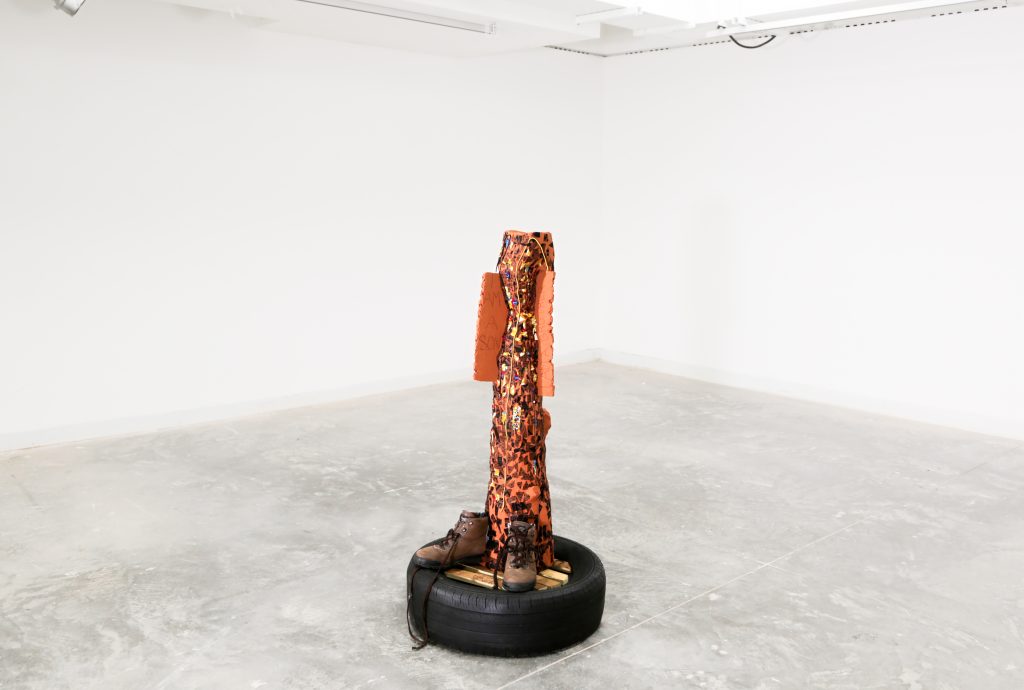
In the work Signpost, a pair of boots is shown on a tire, supporting a column wrapped in fabrics. If this piece functions conceptually as a “signpost” or road sign for contemporary diasporas, where does it point? What message does it give to the traveler who stops to look at it?
In Signpost, the work does not point to a specific destination but to the experience of movement itself. The boots and tire symbolizes the migrant body in motion, carrying memories of labor, endurance, and the uncertainty of every journey. The fabric-wrapped column represents identity, memory, and the fragments of home we carry with us. Rather than offering directions, the work invites viewers to reflect on what they carry, what they have left behind, and how movement transforms us. Signpost asserts that belonging is not a final destination but something we continually create through movement, resilience, and adaptation.
The conversation continues through the works in What Lies Beyond the Visible, his current online solo show.