
What Lies Beyond the Visible
A Conversation with Eugene Agyei
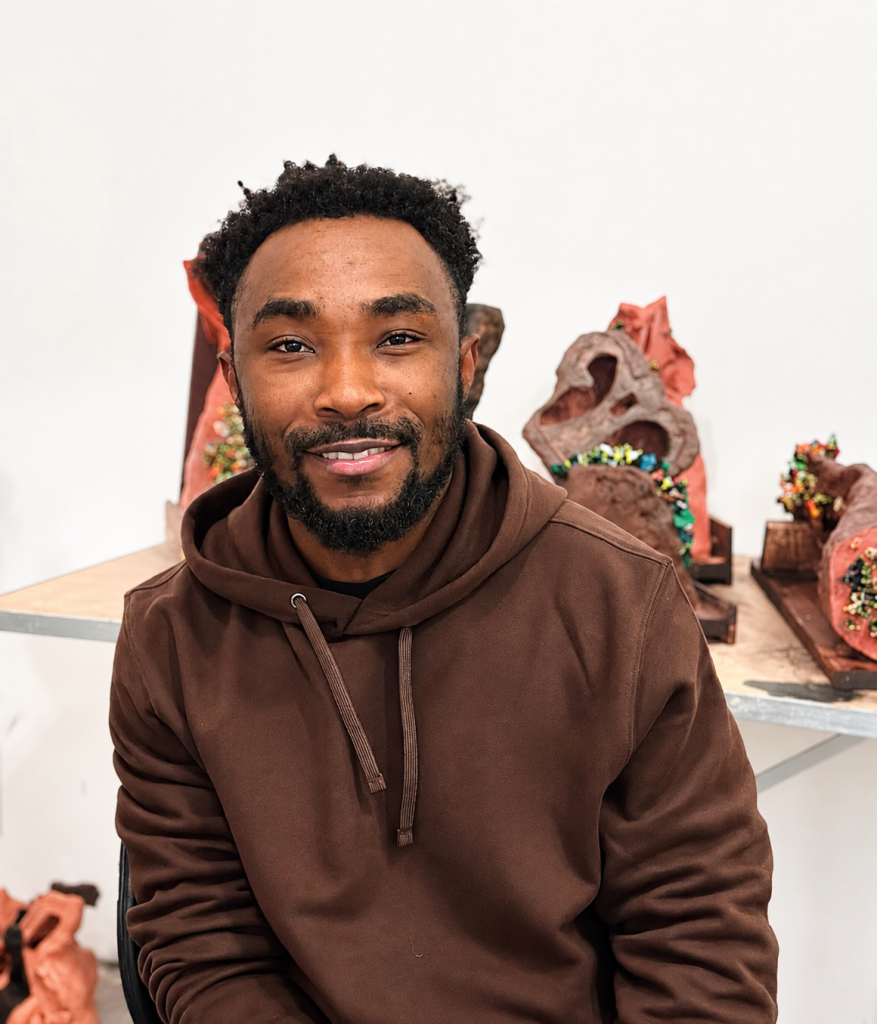
Eugene Ofori Agyei
Courtesy of the artist
In the pottery tradition of Ghana, especially within the Akan community, the coil building technique is a craft historically passed down and practiced by women. Did you use this manual method for some of the pieces that are part of this show? As a male artist in the diaspora, what emotional meaning or sense of rootedness does adopting traditionally female knowledge to mold your pieces hold for you?
Yes, the ceramic components in the works; are built using the traditional coil-building technique that I learned by observing Akan women while growing up in Ghana. In my Akan community, pottery has long been a practice passed down through generations of women.
As a male artist in the diaspora, using this method is not about claiming a tradition that was never mine, but about honoring the women whose knowledge and labor have sustained it. Through contemporary forms, heavy textures, and unconventional materials, I extend that tradition while remaining connected to its origins.
Living away from Ghana has taught me that traditions travel and evolve. Every coil becomes a tactile connection to home, allowing me to reflect on migration, identity, and belonging. The process reminds me that home is not only a place we return to, but something we carry with us through memory, embodied knowledge, and the act of making.
You are Akan in your home, Ghanaian in other African countries, and African in the United States. How does this fragmentation or “layers” of identity translate when you are in the studio? Do you feel that each material you choose (clay, fabrics, found objects) represents each of these layers specifically?
Identity, for me, is not singular or fixed. It continues to shift depending on where I am and how I am perceived. At home in Ghana, I am Akan. In other parts of Africa, I am Ghanaian. In the United States, I became African, Black, and an immigrant. These layers of identity remind me that belonging is always relational, it changes through geography, history, and social context.
In the studio, I embrace these layers instead of trying to separate them. The materials I work with allow me to bring these different experiences together. Clay connects me to the earth. It records my emotions, humbles me, and connects me to my ancestors and the traditional knowledge of Ghanaian pottery practices. It carries the memory of place and the hands that shaped it before me. Building with clay becomes a physical conversation with my cultural roots.
Fabric, especially batik, speaks to movement, exchange, and the complexity of cultural histories. Batik itself has traveled across continents, from Indonesia, through Ghana, and into my own practice. Its journey reflects how cultures are never isolated but are constantly shaped through migration, trade, and human connection.
Found objects speak to displacement, adaptation, and the act of creating home in unfamiliar places. They carry traces of previous lives and histories, much like migrants carry memories of the places they have left behind. I am interested in how these materials hold evidence of movement, value, second chance and transformation.
Rather than assigning each material to a specific identity, I see them as overlapping narratives. Clay, fabric, wood, and found objects come together in the same way my identities coexist. The studio becomes a space where these fragments meet, negotiate, and transform into something new—a visual language that reflects what it means to be rooted in one place while continually becoming through movement.
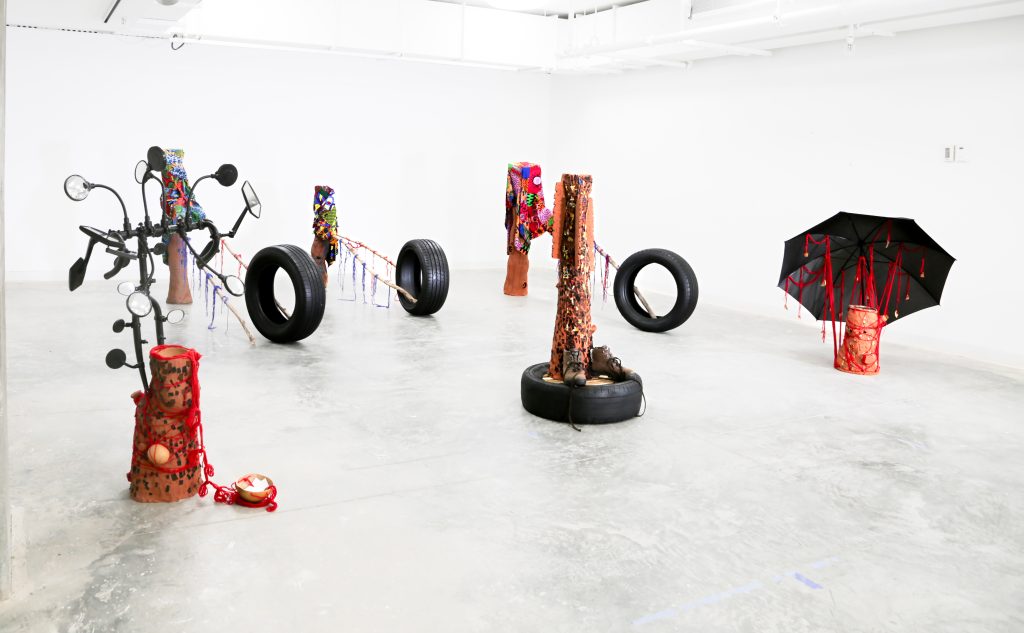
Eugene Ofori Agyei
Install View
2024
Variable measurements
From your perspective, do you experience the union of the materials you use as an encounter and a harmonious reconciliation between your past and your present?
Yes, I experience the combination of these materials as an encounter between my past and my present, but I would not describe it as a complete reconciliation. Instead, it is an ongoing conversation—a space where different histories, memories, and experiences can exist together.
Each material carries its own journey and memory. Clay connects me to Ghana, to the earth, to ancestral knowledge, and to the hands of the women potters who preserved these techniques across generations. It represents a sense of origin and continuity. Fabric, particularly batik, speaks to movement, cultural exchange, and the layered histories that shape identity. Its own journey across continents mirrors my experience of migration and belonging. Found objects and reclaimed materials reflect adaptation, value, second chance —the ways we create meaning from what we encounter and how we build a sense of home in unfamiliar places.
When these materials come together, they do not erase their differences. Instead, they create a space where those differences can coexist. I think of them as fragments of a larger narrative, much like my own identity as an Akan person, a Ghanaian, an African, and an immigrant in the United States.
The studio becomes a place of negotiation and transformation. Through making, I am not trying to return to a singular past or fully merge into a new present. I am interested in the space between—the emotional and cultural terrain where memories, traditions, and new experiences overlap. The materials become witnesses to that journey, carrying traces of where I have been while helping me imagine where I am going.
The conversation continues through the works in What Lies Beyond the Visible, his current online solo show.