
The Blind Spot in the Art Market: Why Banks Are Missing the Greatest Opportunity in Emerging and Mid-Career Art
For decades, the world’s major banks and wealth management firms have approached the art market with a singular obsession: blue-chip art. Picassos, Basquiats, Warhols, Rothkos, Monets, and Koons have become the preferred instruments of prestige finance. Banks built advisory divisions around them, structured lending products against them, and promoted them as alternative assets to ultra-high-net-worth clients. In doing so, they believed they were chasing safety, liquidity, and prestige.
But in reality, many of these institutions have mistaken visibility for vision.
As the largest intergenerational transfer of wealth in modern history unfolds (estimated in the tens of trillions of dollars over the next two decades), banks are dangerously exposed to a changing psychology among heirs, younger collectors, and emerging affluent buyers. The next generation is not merely inheriting wealth. They are inheriting values, frustrations, skepticism, and entirely new cultural behaviors.
And nowhere is this more evident than in the art market.
The Next Generation Does Not Want the Old Kingdom
A defining reality is beginning to emerge: many heirs will inherit enormous collections of art they neither emotionally connect with nor culturally identify with.
Thousands of younger inheritors are poised to receive collections assembled by parents and grandparents during the height of the postwar and contemporary blue-chip boom. Yet these collections often represent older systems of status, exclusivity, opacity, and social signaling that younger generations increasingly reject.
For many heirs, inherited art is becoming less a symbol of aspiration and more a burden of maintenance, insurance, storage, and social expectation.
This shift matters profoundly.
The established art market assumes that value naturally perpetuates itself through lineage and that the children of collectors will become collectors of the same artists. But generational behavior in virtually every other industry demonstrates otherwise. Younger generations routinely abandon legacy consumption patterns in favor of authenticity, accessibility, ethics, and participation.
The same is happening in art.
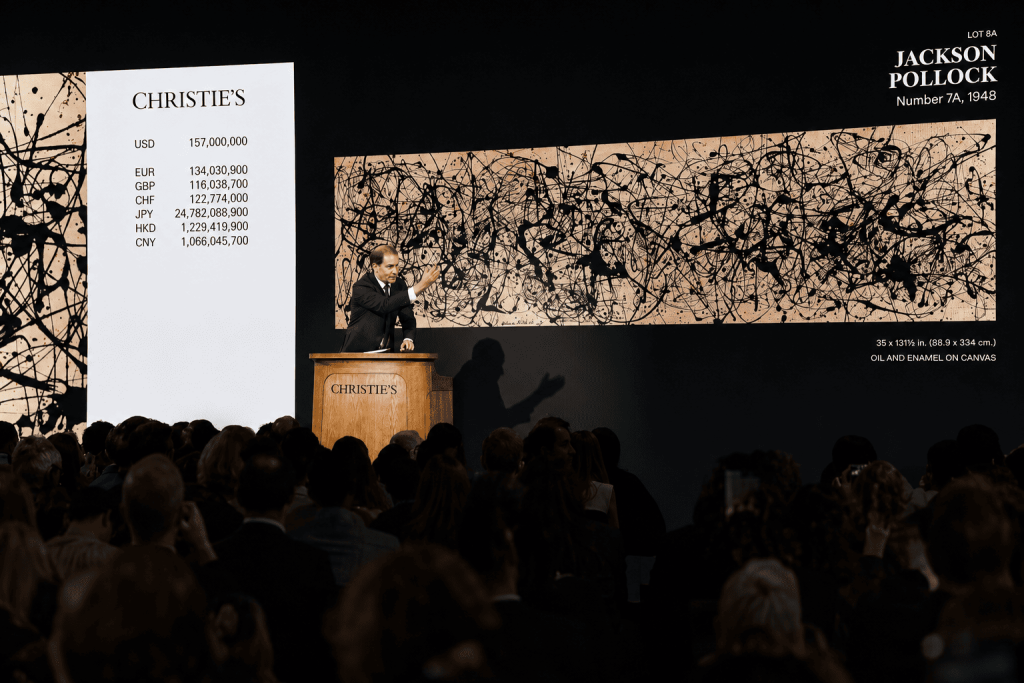
“Number 7A, 1948,” by Jackson Pollock, one of the treasures of S.I. Newhouse’s collection at Christie’s on Monday, May 18, 2026, sold for $181.2 million with fees. Christie's Images.

https://www.finestresullarte.info/en/market/christie-s-surpasses-1-1-billion-overnight-pollock-brancusi-and-rothko-sold-for-crazy-sums
The Collapse of Trust in the Traditional Art Market
The younger generation’s discomfort extends beyond aesthetics. It is increasingly moral and structural.
They are deeply skeptical of the “shenanigans” that define much of the traditional art market:
opaque pricing, insider dealing, artificial scarcity, market manipulation, undisclosed guarantees,
speculative flipping, conflicts of interest, and a culture where value is often dictated by a tiny network of gatekeepers.
Many younger wealthy individuals see the traditional art ecosystem not as sophisticated, but as antiquated and performative.
The irony is profound: while banks have spent years promoting blue-chip art as a sophisticated asset class, younger generations increasingly view portions of that market as resembling a closed cartel.
This distrust creates a historic opening.
By: Fernando Luis Alvarez founder of the emerging artist contemporary art gallery and the Clementina Arts Foundation
May 12, 2026